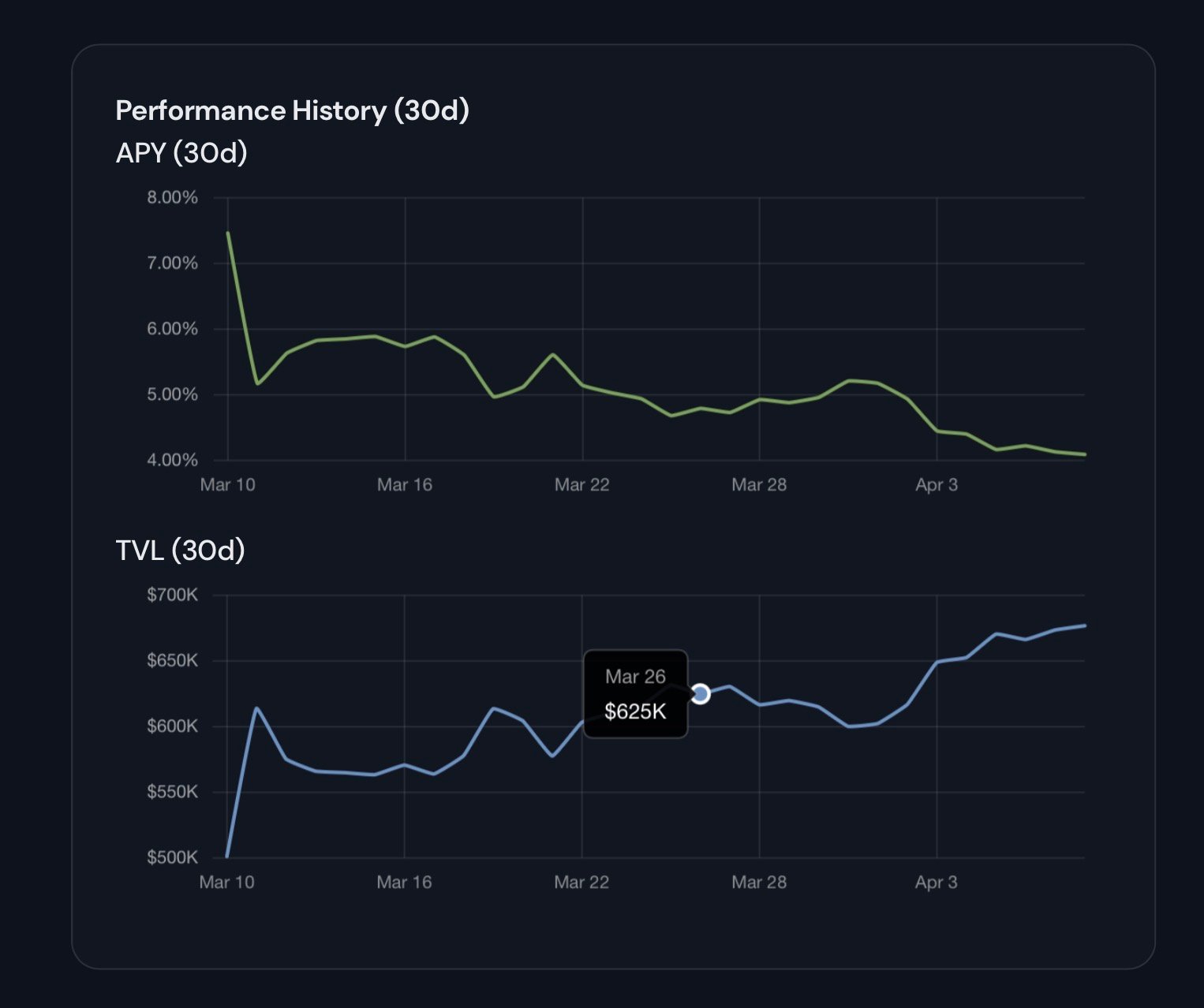
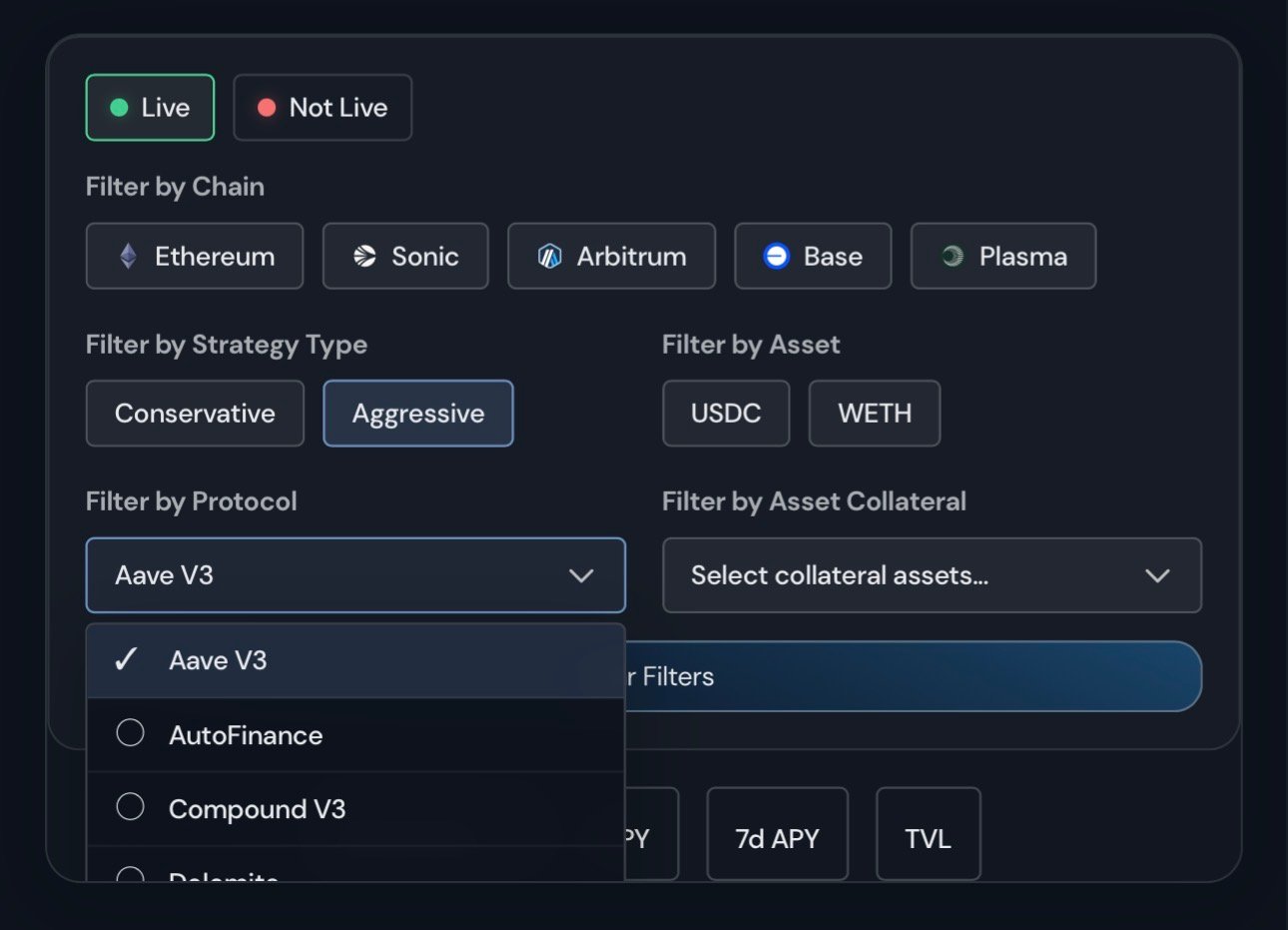
Every pool your Agent can use has been reviewed by us first, and it stays under watch for as long as there’s money in it.The work happens in three steps. Before a pool goes live, our risk team looks at the protocol, the collateral behind it and the pool itself, and decides which strategy tier it belongs to. Once it’s live, its numbers are refreshed throughout the day and checked against the limits of that tier.When something goes wrong, the engine doesn’t wait for its next scheduled run. Risk events such as a depeg, an oracle gap or an exploit in progress are sent to it the moment they’re detected, and it stops new deposits or pulls the funds out.How a pool gets in, how it’s watched, and how risk reaches the engine.
Strategy Tiers
What Conservative, Aggressive and Yield Maxxing each allow.
Whitelisting
What a protocol, a collateral and a pool need to get in.
Ongoing Monitoring
What we watch once a pool is live, and when we stop or exit.
Incident Response
What happens when something breaks.
Every live pool’s rating, checks and alerts are on the Risk Dashboard.
Every pool sits in one of three tiers. The tier tells you how much risk you’re taking, and it comes mostly from one question: what is the pool actually exposed to?
Conservative
5–8% target return.
For capital you want to keep safe first.
Aggressive
8–14% target return.
More yield, with riskier collateral allowed.
Yield Maxxing
10–18% target return.
Highest yield, with slower withdrawals on some pools.
Targets are native returns without incentives, averaged across market cycles over roughly three years.
We look through each pool to the collateral behind it, and measure how much of the pool’s exposure sits in collateral of each tier. A pool gets the first tier whose caps it meets:
Pool tier
Conservative collateral
Aggressive collateral
Yield Maxxing collateral
Risky collateral
Conservative
at least 70%
up to 30%
none
none
Aggressive
no limit
no limit
up to 30%
up to 5%
Yield Maxxing
no limit
no limit
no limit
up to 15%
Risky means collateral that fails even the Yield Maxxing criteria. Each collateral’s own tier comes from Collateral Whitelisting.
Exposures of 0.5% or less are ignored as dust. If less than 60% of a pool’s exposure has been reviewed, we don’t guess: the pool is marked as having insufficient data.
Conservative pools never use leverage or looping.Exposure moves as curators reallocate, so these caps are checked again every night. See Pool Monitoring. For how strategies are picked and customized, see Yield Strategies.
Lending pools are only as safe as the collateral borrowers post. Each collateral is reviewed on its own, using CoinGecko, Chainlink and Pyth feeds, GeckoTerminal, DexScreener and the issuer’s documentation.A collateral gets a tier only if it passes every line for that tier:
Criterion
Conservative
Aggressive
Yield Maxxing
Market cap
≥ $100M
≥ $30M
≥ $20M
Liquidity (onchain TVL or slippage on a $1M trade)
≥ $25M or ≤ 0.2%
≥ $3M or ≤ 1%
≥ $1M or ≤ 1.5%
7-day average volume
≥ $1M/day
≥ $300K/day
no minimum
Depeg (max drawdown over 6 months)
≤ 0.5%
≤ 5%
≤ 5%
It also needs enough backing for its category:
Asset category
Conservative
Aggressive
Yield Maxxing
Stablecoins / delta-neutral strategies
≥ 100%
≥ 100%
≥ 100%
ETH LSTs / LRTs
≥ 100%
≥ 100%
≥ 100%
BTC LSTs
≥ 100%
≥ 100%
≥ 100%
Tokenized real-world asset funds
≥ 100%
≥ 100%
≥ 100%
Tokenized stocks / BTC / ETH wrappers
≥ 125%
≥ 115%
≥ 100%
Other (algorithmic / hybrid / synthetic)
≥ 140%
≥ 130%
≥ 100%
A depeg only counts if it lasts at least 8 hours with at least $5K of trading volume, so a short wick on a thin market doesn’t disqualify an asset. If data is missing on two or more lines, the asset is marked as having insufficient data instead of being given a tier.
New pools are reviewed every day. Some rules apply to every pool, and vaults and lending markets each have their own on top.
All pools
Vaults
Lending markets
Check
Rule
Protocol
Whitelisted
Collateral
Only whitelisted collateral
Size
Pool TVL and liquidity meet the tier minimum (Also required)
A curated vault, like a Morpho vault, doesn’t lend on its own. A curator decides which markets it lends into, and that can change any day. So we judge a vault by what’s inside it, not by its name.We map the whole tree, from the vault to the markets it lends into to the collateral behind each market. Every collateral in it has to be whitelisted, and the mix has to fit the exposure caps of the vault’s tier.An example vault: 80% of its exposure is Conservative collateral, so it fits the Conservative caps.
A lending market is a single pair: one collateral, one borrowed asset. It values the collateral with an oracle, and the kind of oracle depends on the pair:
Market price: the live trading price. Used when the collateral and the borrowed asset move independently, like cbBTC/USDC.
Exchange rate: the rate at which a token can be redeemed for what’s behind it. Used when both sides track the same thing, like wstETH/ETH.
Fixed price: hardcoded, it never moves. It’s the simplest, but if the collateral depegs the market won’t see it. That’s why we only allow it in Yield Maxxing.
The pair also sets the maximum LLTV: how much can be borrowed against the collateral before liquidation.
Getting whitelisted is the start, not the end. Markets change, curators reallocate, and a pool that was fine last week can turn. So every live pool is checked in two ways:
On a schedule: pool metrics are refreshed through the day, and every collateral and pool is re-rated each night.
On events: a depeg, an oracle gap or an exploit in progress is sent to the engine as soon as it’s detected, without waiting for the next run.
Each check can do one of two things. It can stop new money going in while existing positions stay put, or it can move existing funds out. See also our Security Agents & Human Team and Emergency Response.
Daily re-rating: every day, each collateral’s backing and every rule of its tier are checked again from fresh data. If the result no longer matches its tier, the risk team is alerted.
Depegs: base assets and collateral stablecoins are watched for peg breaks as they happen.
New collateral: when a curator adds a collateral to a vault we use, it’s flagged and reviewed against the collateral criteria.
These checks run on every live pool, whatever its type.
Check
Stops new deposits
Moves funds out
TVL stability
TVL down 40% from its 30-day high
Same
APY and TVL together
APY 2σ above its mean while TVL is down 20%
Same
Liquidity
Deposit would take our share above 85% of liquidity
Our share is above 85% of liquidity
Collateral health
Collateral flagged unhealthy
Same
On top of the all-pool checks:
Nightly exposure check: the vault’s mix is measured again every night against the exposure caps. If its tier has fallen below what its strategy allows, it’s flagged as drift and the risk team reviews it.
Curator changes: when the curator adds a new collateral or market, it’s flagged and reviewed against the collateral criteria, and the map of the vault is updated.
On top of the all-pool checks, four things are watched:
Oracle: we compare the price the market’s oracle reports with the collateral’s real market price. A gap means the market is valuing the collateral wrong, which matters most for exchange-rate and fixed oracles since they don’t follow the market.
Borrower health: we look at how much of the market’s debt belongs to borrowers who are close to being liquidated. If a lot of it is, one sharp price move could leave bad debt behind.
Utilization: how much of the market is borrowed. Near 100%, lenders can’t withdraw.
Losses: any drop in the market’s share price, or any bad debt.
“Near liquidation” means a borrower’s LTV is within 5 points of the market’s LLTV. If any of this data is missing, deposits stop, but nothing is pulled out on missing data alone.
When something breaks, the engine acts first and people review after. Automatic actions protect funds in the minutes that matter. The risk team then looks at what happened and decides whether a rating should change. Ratings are only ever changed by a person.
Alert
What triggers it
What happens
Depeg
The base asset or a collateral loses its peg
Deposits stop. Funds move out of affected pools.
Exploit
Glider by Hexens detects an attack touching a vault we use